

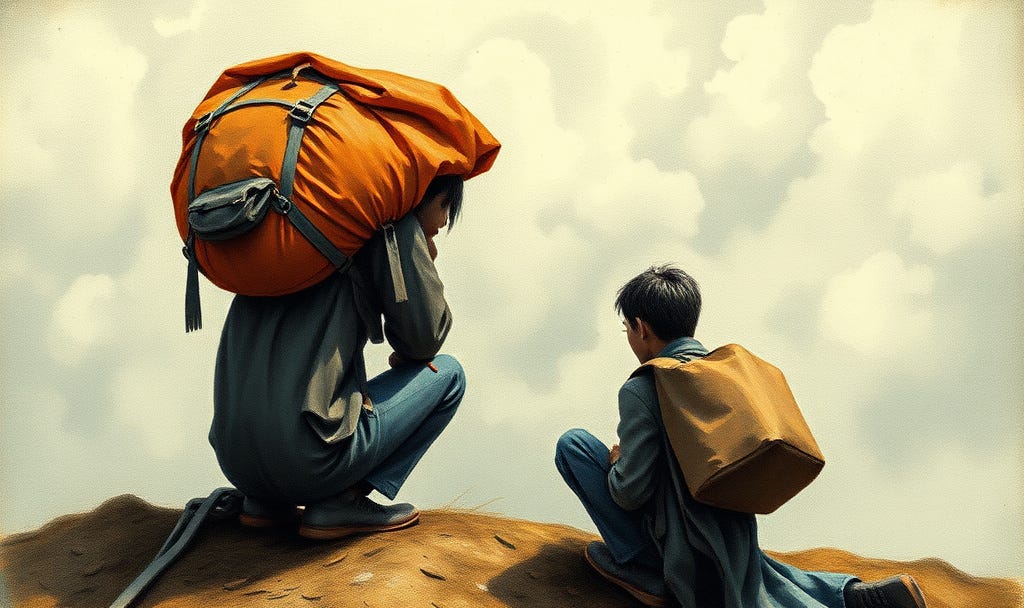
Many of us spend our lives caught between two things: the weight of the past and the fear of the future. It sounds simple, but it affects almost everyone. People often carry heavy emotional loads that come from childhood experiences, past relationships, failures, or trauma. At the same time, many worry endlessly about what tomorrow may bring, whether their plans will work out, whether they will earn enough, or whether their children will succeed. Because of this, the present moment, which is the only real moment we truly have, slips away unnoticed.
Let’s begin with the past. Human memory is powerful. People remember things deeply, especially painful experiences. In many families, childhood was not always easy. For example, a boy from a rural village might recall how he was constantly compared to others and made to feel inadequate. Even as an adult, he may still hear those voices in his head telling him he is not good enough. Or consider a woman from an urban area whose early relationship ended badly. Maybe she faced betrayal or emotional abuse. Even after moving on in life, those memories might still hurt her. She may struggle to trust again, or feel that she is not worthy of love.
These experiences are real and painful. And for many, they become like a prison. They replay the same memories again and again. They feel stuck. They carry sadness and shame for years, long after the events have ended. Even though the past is gone, it continues to live in their mind as if it is happening right now.
We often tell people to “forget and move on.” But healing does not happen just because someone tells you to forget. The brain holds on to memories for its own reasons. And many people do not even realize how much their past is shaping their present reactions, relationships, and decisions. For them, enjoying the present becomes almost impossible, because the past keeps pulling them back.
On the other side is fear of the future. The future is uncertain, and uncertainty can be frightening. People worry: “Will I get a job?” “Will my business survive?” “Will my children pass their exams?” “What if something bad happens?” This fear becomes even stronger in Nepali society where economic challenges, family responsibilities, and social expectations are high.
Take the example of a young man working abroad. His future is full of uncertainty. He worries about his visa, his work permit, the money he sends home, and whether he will ever return to Nepal and start a stable life. Because of his constant worry about the future, he struggles to appreciate the present moments around him, like talking with friends, enjoying a simple cup of tea, or taking a quiet walk in the evening.
Or think about parents who worry endlessly about their children’s future. They push their children to study harder, take more tuition classes, get higher marks. In this race, parents often lose the chance to enjoy the small joys of their children’s present life: their laughter, their growth, their innocence. The children, too, lose their own sense of peace, always worrying about what will happen next.
In both cases, the present moment becomes invisible. Yet the present is the only moment that is real. The blue sky above you right now is real. The mountains you see on a clear morning are real. The person sitting next to you at the tea shop is real. The warmth of a conversation, the smell of freshly cooked dal bhat, the sound of birds early in the morning, these are the present moments that life is made of. But many people miss them because they are locked in the past or anxious about the future.
Mindfulness teaches us something very simple but very powerful: be here right now. Not by force, not by pretending things are perfect, but by gently bringing your attention back to the present. Mindfulness does not ask you to erase your past. It simply asks you to acknowledge it without letting it control your life. It does not ask you to ignore the future. It just teaches you not to live in fear of it.
Mindfulness can be practiced in very simple ways. For example, when you drink your morning tea, just drink it. Notice its warmth, its smell, its taste. Instead of scrolling through your phone or worrying about the whole day ahead, take those few minutes to be present. When you walk to your office or to the market, notice your surroundings. The vegetable sellers, the sound of buses, the laughter of school children in their uniforms. These simple moments bring you back to the present.
Another example: imagine you are sitting with your family in the evening. Normally, your mind might run to past problems or future worries. But mindfulness teaches you to listen fully when someone speaks, to observe their expressions, to feel the connection. This is how relationships grow. This is how peace grows.
For those who feel stuck in their past, mindfulness offers a slow but steady way forward. Instead of trying to “escape” the past, mindfulness teaches you to observe your memories and emotions without drowning in them. Over time, this reduces their power over you. For example, someone who faced childhood hardship can slowly learn to feel compassion for their younger self instead of shame. Someone who had a painful breakup can learn to recognize the hurt without letting it shape their entire identity.
For those who are afraid of the future, mindfulness reduces anxiety by bringing attention to the present tasks. If you focus on the work you are doing today, you naturally reduce the fear of everything that might happen tomorrow. A farmer ploughing his field can focus on the soil and the rhythm of his work. A student preparing for exams can focus on one chapter at a time instead of panicking about the entire syllabus. A shopkeeper can focus on serving the customer in front of him instead of worrying about next month’s rent.
Mindfulness does not solve all problems instantly. It is not magic. But it slowly breaks the chains that keep you imprisoned. It shows you that life is happening here and now. And if you learn to be present in each moment, you begin to feel lighter, calmer, and more alive. In the end, life is not found in the past or in the future. It is found in the present. And mindfulness is the key that helps you truly live it.
Living in the past feels so real that we literally experience the same pain again, as if it is happening right now. It becomes so hard ,so unbearably hard that no one can truly imagine it unless they have lived it.
Sometimes it feels like I will never be able to overcome it. Even willpower does not seem to work here.
It is easy for people to say, “She has also been through the same, but look at her.” It is easy to say, “You have your own people.” But pain is not a comparison, and presence is not always the same as support.
Right now, I honestly don’t know what will happen to me, whether I will keep drowning in it, or whether I will somehow float and move forward.
I am trying to move forward floating in it.
But right now, I am struggling.
And I feel drowned.